SME Cyber Security: Perception Is Not Assurance
Your business may be less protected than you think. Experts checked what Western Australian SMEs said about their cyber security. The gap was bigger than expected. The lesson for business owners is simple: believing your business is protected is not the same as knowing it is.At CyberCon 2026, Dr Alladean Chidukwani presented "Perception is not assurance: What validated assessments reveal about SME cyber security". His study asked a simple question: do small and medium businesses have the security measures they believe are in place?
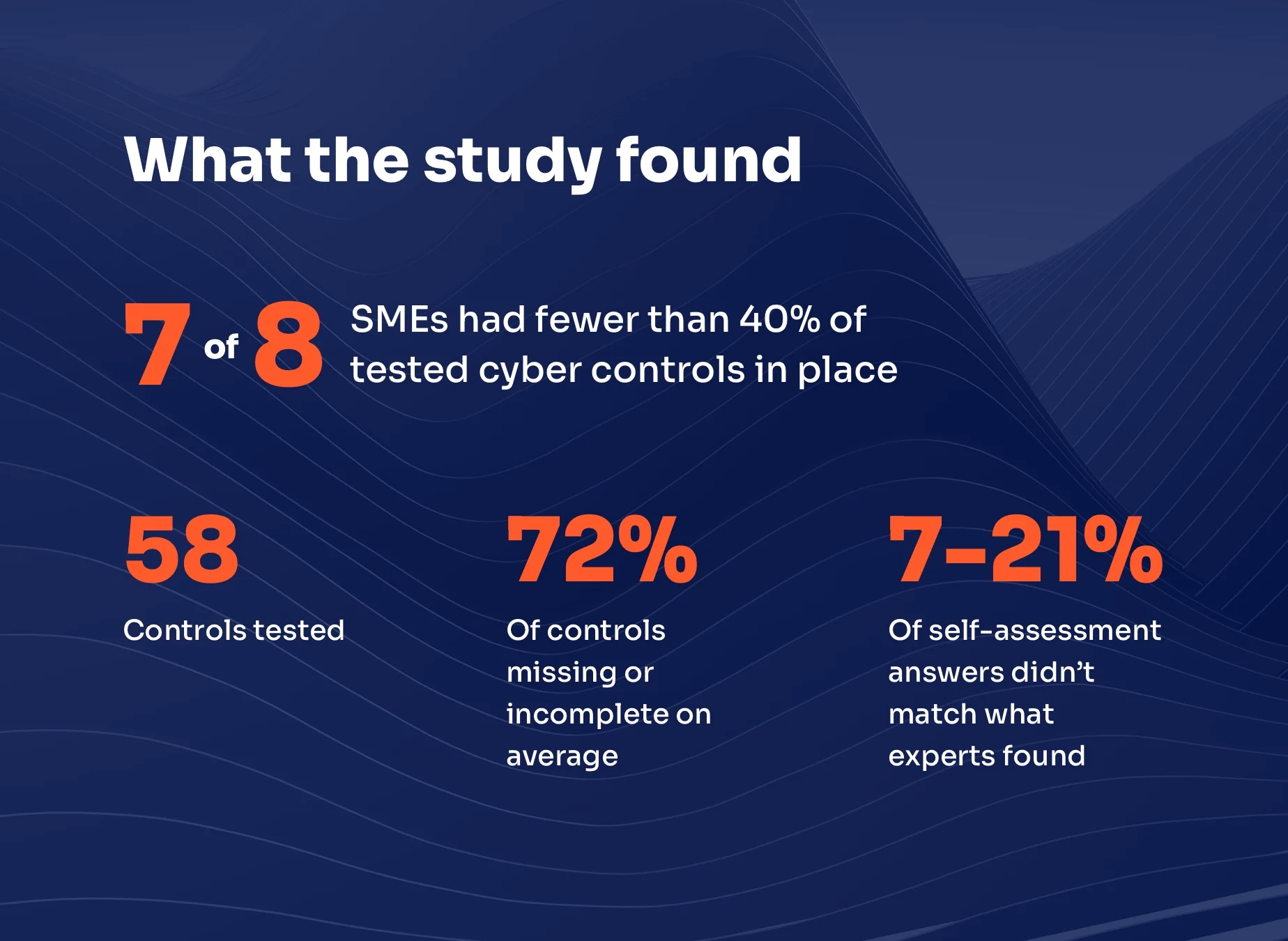
In short: 7 of 8 businesses studied had fewer than 40% of the tested security controls in place, and their self-assessments didn't always match what experts found.
How the study worked
From January 2024 to March 2025, 8 SMEs in Western Australia were assessed against 58 controls aligned to the NIST Cybersecurity Framework.
Each business had first completed a self-assessment survey.
Researchers then checked those answers through site visits, interviews with key staff, a review of policies and other documents, and network vulnerability scans.
The results were surprising:
- 7 of 8 businesses had fewer than 40% of the security controls in place. The strongest had 60%. The weakest had just 2%.
- On average, 72% of the security measures were either missing or only partly in place.
- For 7–21% of the controls, what businesses reported in their self-assessment didn't match what the experts found.
The SMEs (fewer than 5 to 150 employees) included not-for-profits, health care providers, an agricultural business and software developers.
Most of them used a third-party IT provider. 6 of 8 had already experienced a cyber attack.
What the validated assessments found
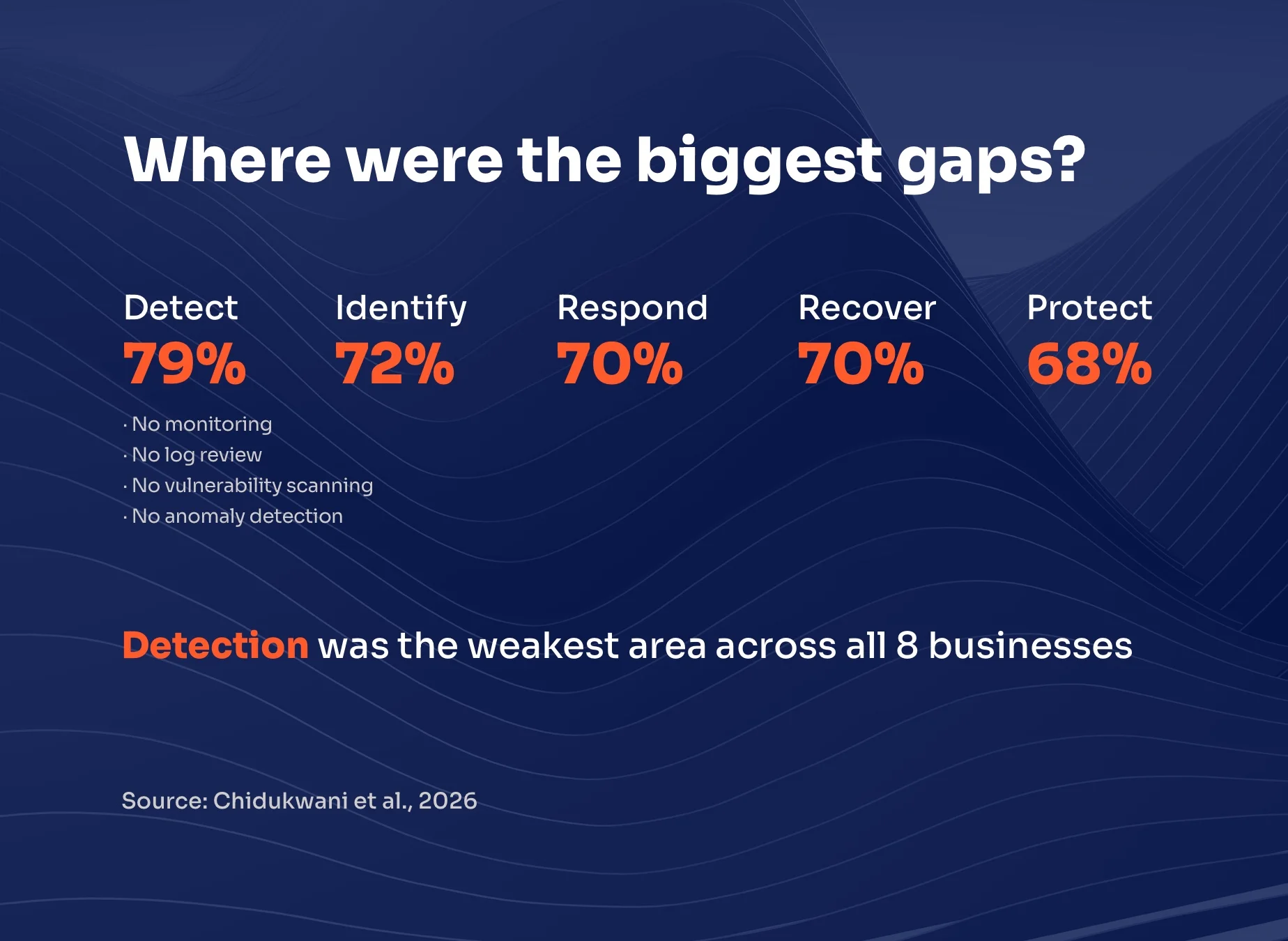
- Detection was the biggest weakness. 79% of detection controls were missing or only partly in place. Many businesses had no monitoring, no log review, no vulnerability scanning and no anomaly detection. As one slide put it: "You cannot respond to what you cannot see."
- Many security problems were basic and preventable. End-of-life systems, missing security updates, weak permissions, incomplete MFA, and devices that were overlooked or not properly protected. None of the businesses had carried out a comprehensive scan of their networks to identify security weaknesses.
- SMEs confuse IT support with cyber security. Many small businesses rely on external IT providers to manage computers, email and software. But keeping technology running is not the same as actively protecting it from cyber attacks.
- Service providers were vulnerable too. 2 of 8 SMEs were technology service providers and software vendors trusted by other businesses. Validation found end-of-life operating systems, critical unpatched vulnerabilities, default credentials, weak authentication, and no secure development lifecycle, application security testing, SBOM or penetration testing.
Definitions
| Term | What it means |
|---|---|
| MFA (multi-factor authentication) | An extra login check, such as a temporary code or approval on your phone. |
| Vulnerability scanning | Checking computers, devices and systems for known security weaknesses. |
| Patching | Installing updates that fix security weaknesses in software. |
| End-of-life systems | Software or devices that no longer receive security updates from the manufacturer. |
| Logs and monitoring | Logs are records of activity on systems. Monitoring means someone reviews them for suspicious behaviour. |
| Offboarding | Removing a departing employee's access to company systems and data. |
| Secure development lifecycle | Building security checks into every stage of software development. |
| SBOM (software bill of materials) | A list of the software components used in a software product. |
| Governance | Clear responsibility, oversight and decision-making. |
Examples from the assessments
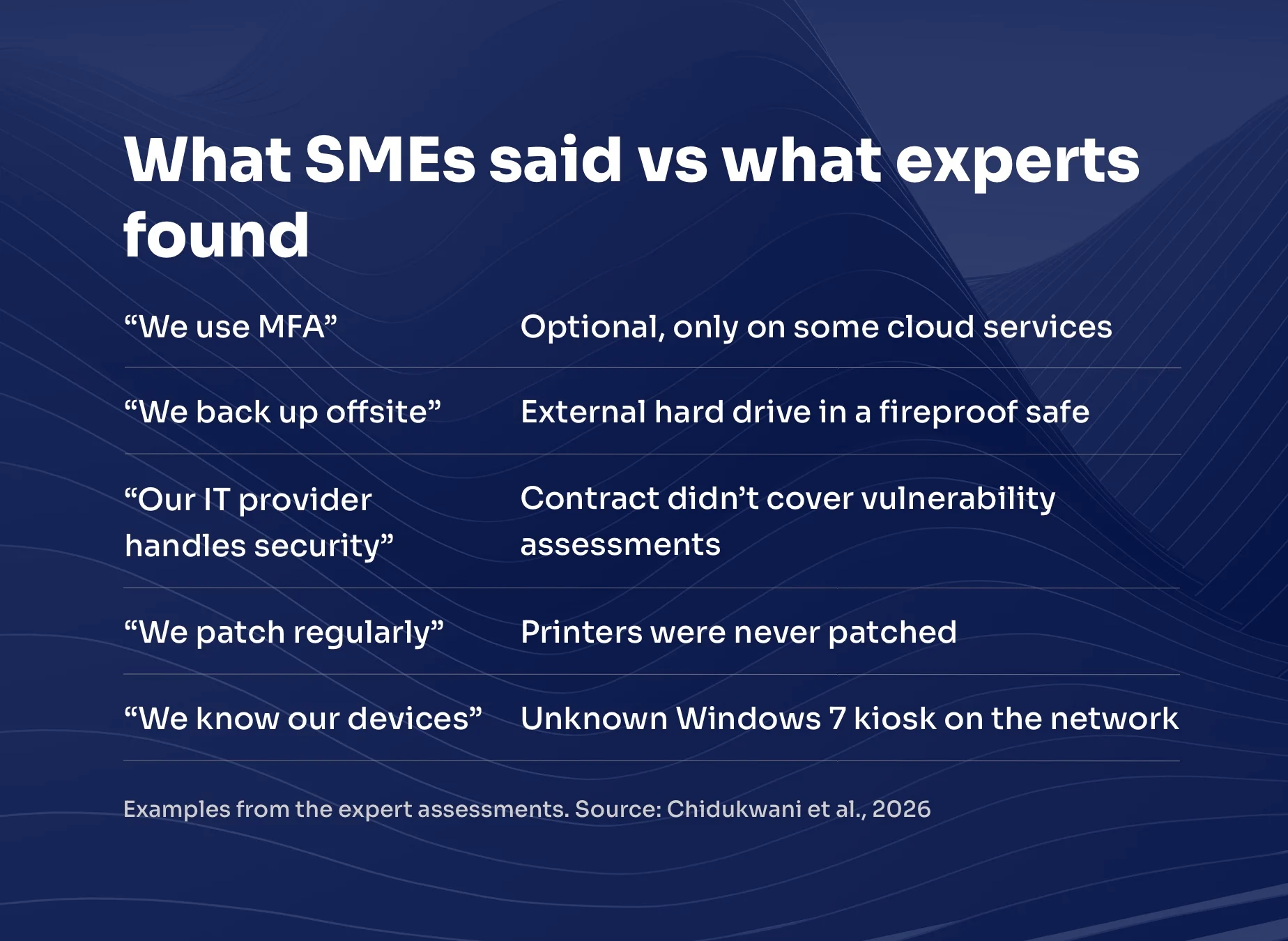
The published study gives concrete examples of the gap between what businesses believed and what was actually in place:
- MFA was often optional. Several businesses said they used MFA, but it was only enforced on some cloud services and not on other internet-facing systems.
- Backups weren't what people thought. One business had never backed up its data because it assumed its cloud provider did.
- An unknown device on the network. At one business, researchers found an old kiosk running Windows 7 which may have been compromised during an earlier cyber incident.
- IT contracts didn't cover cyber security. Management believed the provider was handling vulnerability assessments, but the contract didn't include them.
- No staff training or offboarding. None of the businesses provided phishing awareness training, and none had a documented process for removing access when staff left.
- Privacy obligations were missed. Two health care providers didn't realise the Notifiable Data Breaches scheme applied to them regardless of turnover, and a business with revenue over $3 million was unaware of its reporting obligations.
Why the perception-practice gap exists
The talk identified 4 main reasons businesses may believe their cyber security is stronger than it really is:
- Behavioural: optimism bias ("we're probably okay"), overconfidence, and assuming controls exist without checking.
- Governance: nobody accountable, undefined ownership of cyber risk, missing policies, and cyber treated as an IT issue rather than a business risk. Only 3 of 8 businesses had clearly assigned cyber security responsibilities, and none had a dedicated cyber security budget.
- Resources: limited budgets, skills shortages and competing priorities.
- Ecosystem: reliance on MSPs and IT providers, and contracts that are vague about who is responsible for security.
Dr Chidukwani's summary: cyber security failures are governance failures.
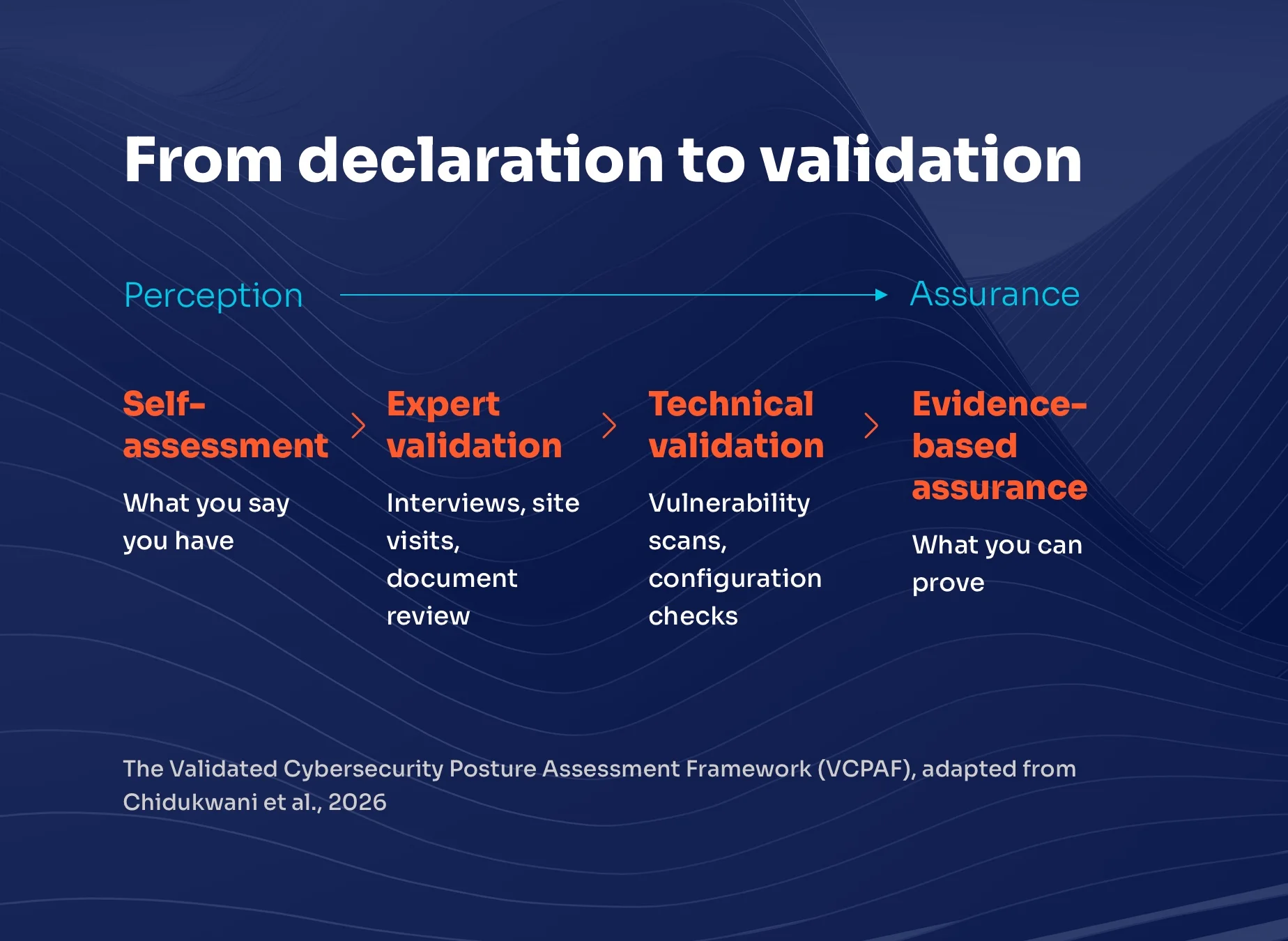
The way forward: from declaration to validation
Dr Chidukwani proposed a 4-stage approach to understanding how well a business is protected:
- Self-assessment (perception-based): Identify the security measures you believe are in place.
- Expert validation: Have a specialist review your policies, documents and processes through interviews and site visits.
- Technical validation: Check your devices, software and network for security weaknesses.
- Evidence-based assurance: Use a validated assessment your business, its customers and suppliers can rely on.
The study also recommends clearer IT provider contracts that list which cyber security services are included and which are not, and standard terms for IT and cyber security services.
The authors compare this to health insurance, where standard cover categories make it easier to see what a policy includes.
How this connects to his research
The CyberCon talk drew on the studies by Dr Chidukwani, Sebastian Zander and Polychronis Koutsakis at Murdoch University.
The findings suggest the blind spot identified in their 2022 review of SME cyber security research, which found very little work on detecting, responding to and recovering from attacks, exists in practice too: detection was the weakest area in the businesses assessed.
It's also worth noting that NIST CSF 2.0 (2024) added a sixth function, Govern, which puts governance at the centre of the framework.
The study used the five original NIST CSF functions, but its findings fit closely with the Govern function and his message.
The authors note that the study was small and limited to Western Australia, and that the businesses chose to take part. Businesses that volunteer for a free cyber security assessment may already be more security-conscious than average.
What small businesses should do now
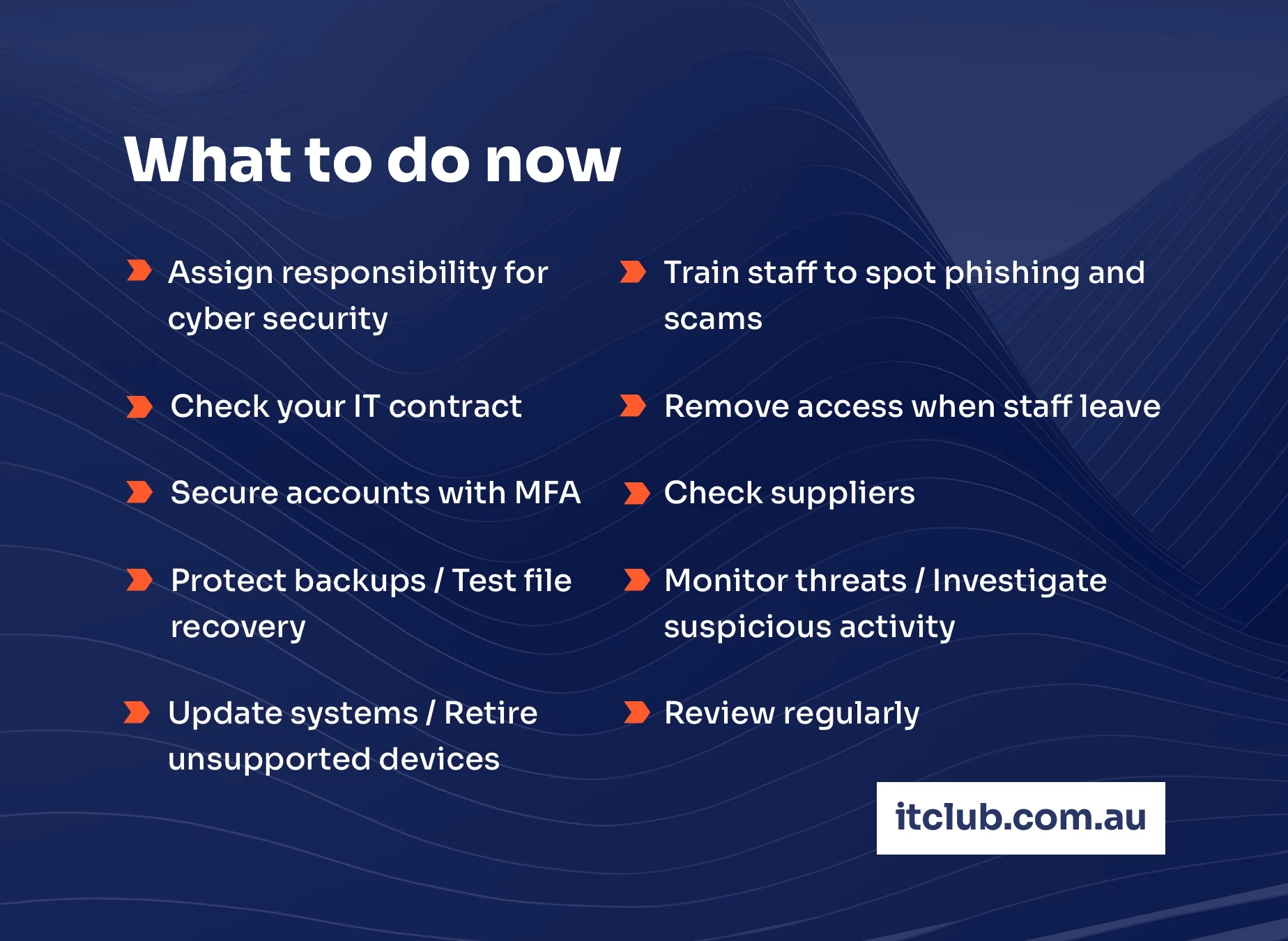
If you run a small business, start here:
- Know who is responsible: Name one person to oversee cyber risk.
- Check your IT contract: Ask your IT provider to confirm in writing which security services are included, and which are not.
- Secure your accounts: Make sure that MFA is enabled on every account.
- Protect your data: Confirm that backups are actually being made, and test that you can restore your files.
- Keep systems updated: Check that computers, printers, routers and other devices receive security updates. Retire unsupported devices.
- Spot a phish: Train staff to spot phishing emails, texts and other common scams.
- Review security alerts and logs: Make sure someone reviews them and investigates suspicious activity.
- Offboard properly: Remove access promptly when employees leave.
- Check your suppliers: Ask important suppliers for evidence of their security controls.
- Keep checking: Review your security regularly rather than relying on a one-off assessment.
Perception is not assurance.
Don't just assume your business is protected. Check what is actually in place.
Where to start (free resources)
Take the first self-assessment step to know where your business stands.
For Australian small businesses, ASD’s Essential Eight is the usual starting point for technical controls, and it covers many of the gaps the study found.
- Get a baseline. Our free Essential Eight Self-Assessment gives you a score, your Maturity Level One result and a printable action plan. It’s anonymous and needs no sign-up.
- Check, don’t assume. The DIY Cyber Security Health Check is a jargon-free checklist you can work through in an afternoon to see where your business is actually exposed.
- Understand the basics. The Essential Eight Explained covers patching, MFA, admin privileges and backups in plain English, which are the same controls the study often found missing.
This article is part of our cyber security for small businesses series.
Sources used
- Dr Alladean Chidukwani, "Perception is not assurance: What validated assessments reveal about SME cyber security", CyberCon 2026 (Australian Cyber Conference), presented by AISA.
- A. Chidukwani, S. Zander and P. Koutsakis, "Beyond self-reporting: Uncovering the operational realities of SME cybersecurity through expert assessment", Computers & Security, vol. 164, 104839, 2026.
- A. Chidukwani, S. Zander and P. Koutsakis, "Cybersecurity preparedness of small-to-medium businesses: A Western Australia study with broader implications", Computers & Security, vol. 145, 104026, 2024.
- A. Chidukwani, S. Zander and P. Koutsakis, "A Survey on the Cyber Security of Small-to-Medium Businesses: Challenges, Research Focus and Recommendations", IEEE Access, vol. 10, pp. 85701–85719, 2022.
- National Institute of Standards and Technology, NIST Cybersecurity Framework 2.0 (2024).
- ASD’s ACSC, Essential Eight explained.
More To Explore
The Essential Eight Explained for Small Businesses
Latitude Financial Data Breach: Lessons for Small Businesses